
The Founders of the Plainfield Public Library
|
| George H. Babcock | |
| Henry E. Daboll | |
| John B. Dumont | |
| John H. Evans | |
| Colonel Mason Whiting Tyler |
George Herman Babcock (1832-1893)
 George H. Babcock was born on June 17, 1832 at Unadilla Forks, New York. He was the second child of Asher M. and Mary E. Stillman Babcock, and descended from a family of inventors and mechanics (on both sides). George grew up in New York State and Rhode Island, where he met Stephen Wilcox, who would later engage in a business partnership with him. George also took up an interest in photography, specifically Daguerreotyping, as a young man. He credited this hobby as having a healing influence on his life, which was threatened with consumption, through the iodine fumes used in the developing process. He remained a successful amateur photographer throughout his entire life.
In 1854, he and his father invented the polychromatic printing press, which would print three colors at once on a paper sheet. He continued to be involved with newspapers, printing presses, and a variety of machinery for several years. During the Civil War, he worked for the Mystic Iron Works in Connecticut building ships for the U.S. government. He became the chief draftsman at the Hope Iron Works in Providence, R.I. In 1867, he established the firm of Babcock & Wilcox with his childhood friend. They incorporated the New York Safety Steam Power Company in 1868, and built engines and boilers. Their most famous invention was the Babcock & Wilcox sectional tubular steam-boiler, and through this and related boilers both gentlemen acquired both fame and fortune.
Mr. Babcock moved to Plainfield in 1870; he lived on West 8th Street, between Arlington and Madison Avenues. He married his first wife, Lucy Adelia Stillman, in 1852; she died in 1861. He married his second wife, Harriet Mandane Clark of Plainfield, in 1862; she passed away in 1881. He married his third wife, Eliza Lua Clark of New York, in 1882. They had 2 children: George and Herman, who only survived for one short month. After Eliza passed away, George married his fourth wife, Eugenia Lewis Louis of Rhode Island, in 1893.
George Babcock was the President of the original board of directors that helped to establish the Plainfield Public Library in 1881. He was also the president of the board of education and the trustees of Alfred University. He loved Bible study and was superintendent of the Sabbath school in Plainfield from 1874 to 1885; he led the school to growth and prosperity. He did much to improve the city of Plainfield through architecture and construction, perhaps most notable was the Babcock Building located at 240 West Front Street.
George Babcock died in Plainfield on December 16, 1893 - only 19 days after his life-long friend and business partner, Stephen Wilcox. He bequeathed the sum of $10,000, as well as some local houses, to the Library for the purchase of “industrial, mechanical, and scientific books” to be designated for the creation of the “Babcock Scientific Library.” This new collection grew to such an extent that the Library Board, wishing to abide by Babcock’s will, planned an addition to the existing building to be erected. The addition was completed in 1900, and extended the lot up to College Place.
Items of Interest
Henry E. Daboll (1844- circa 1920)
Henry E. Daboll was born in Connecticut in 1844. His father was David A. Daboll, grandson of Nathan Daboll - the maker of the famous, "New England Almanac and Farmers Friend,” which began publication in 1773. He had one brother, Nathan (also of Plainfield). Henry was married to Miss Elizabeth “Lizzie” Morgan of Connecticut, a descendant of Captain James Morgan and Nicholas Morgan. Elizabeth passed away in July 1917, and was laid to rest in Groton, CT.
Mr. Daboll worked at Marine Bank and the Continental Trust Company in New York City, but resided on 50 East Sixth Street in Plainfield, NJ (by 1879). He was on the original board of directors that helped to establish the Plainfield Public Library in 1881. He was a supporter of the Plainfield Choral Society. He last appears in the Plainfield City Directories in 1920, residing at 322 East Sixth Street.
Items of Interest
David A. Daboll and the
"New England Almanac and Farmers Friend
(April 22, 1892)
John Brokaw Dumont (1842- circa 1928)
John B. Dumont was born on November 23, 1842 to Peter P. and Auletta M. Brokaw Dumont; he had one brother, Henry. John was a descendant of Peter Dumont, who was a member of the eleventh colonial assembly of New Jersey and one of the first settlers of Somerset County. Peter was the youngest son of Walleram Dumont, a Huguenot who came to America in 1657 as a corps officer of the Dutch West India Company.
John Dumont became a resident of Plainfield in 1869. He married Elizabeth Stewart Cook in 1867; she passed away in 1901. They had three children: a daughter Marion, and two sons, John Jr. and Morris. He remarried on October 6, 1903 to Annie Wright Mason. John was a New York businessman and a member of the New York Stock Exchange, serving on its governing committee for 10 years. He was a member of the Plainfield Common Council, and had been Council President for a total of 10 years (at different times) since 1874. He was the Treasurer of the first board of directors of the Plainfield Public Library, and was also a member of the Grace Church vestry. He resided at 503 Stelle Avenue, known as "The Woods," and died sometime around 1928.
Items of Interest
John H. Evans (d. 1889)
John H. Evans was the second Mayor of Plainfield from 1871 to 1872. He worked at his firm in New York, Wing & Evans, as an importer of chemicals, as well as a stockholder and director of many large corporations. He was also the Vice President of the Sapollo Company - a large owner of the town of Warsaw and its Salt Works.
Mr. Evans married twice and had three sons: Clark Wright Evans, Courtlandt De Lacey Evans, and Louis Melville Evans. He and his second wife, Miss Lewis, had an adopted daughter named May, who was Miss Lewis’ niece.
Mr. Evans was the owner of one of the most elegant homes in Plainfield, the "Oakwood,” which later became the Hartridge School. He was a man of great wealth and charity. The lights at each side of the entrance to the Park Avenue Baptist Church, and the large bronze pillar opposite the Crescent Avenue Church, are some of his public gifts.
He died suddenly of heart failure on March 17, 1889 in his winter residence at the Hotel St. George in Brooklyn, NY. His wife and family were by his side.
Items of Interest
Park Avenue Baptist Church
Crescent Avenue Church
Evans obituary from the Plainfield Daily Press
Walter Levi Hetfield, Jr. (1879-1940)
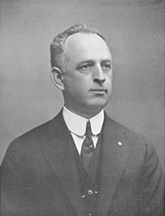 Walter Levi Hetfield, Jr. was born in Plainfield, New Jersey on June 2, 1879 to Walter Sr. and Ella (Daly) Hetfield; he had one brother, Harold. His father was a successful attorney in Plainfield. The Hetfield family had long been residents of the Plainfield area. Walter Jr. graduated from Plainfield High School in 1898. He then studied law and was admitted to the New Jersey bar in 1900. He married Miss Mabel E. Firstbrook, also of Plainfield, on December 15, 1904. They resided at 602 East Front Street. The couple had two sons: Walter III and George F. Walter formed the firm Reed & Hetfield in 1913, which later became Reed, Hetfield & Crane.
Mr. Hetfield was very involved with public affairs, and served with the Union County Board of Electors, as the assistant county prosecuting attorney, and was appointed Prosecuting Attorney in 1918. He was a Republican, and was affiliated with the First Methodist Episcopal Church of Plainfield. He was Secretary of the first board of directors of the Plainfield Public Library. His fraternal memberships included a thirty-second degree member of the Masonic Order, a noble of the Mystic Shrine, the Improved Order of Red Men, the Benevolent and Protective Order of the Elks, and the Order of Foresters.
He passed away in 1940, and is buried in Hillside cemetery.
Items of Interest
Job Male, Plainfield's Grand Old Man (1808-1891)
 Job Male was born in Somersetshire, England on August 24, 1808. He came with his parents to America in 1816 and began to earn his livelihood by attending the toll gate on the Turnpike between Jersey City and Newark. His early education was limited to a few months attendance at school and to the knowledge he was able to acquire while learning his trade of carpentry. He was employed by the Union Ferry Company to build their ferry houses in New York and Brooklyn from 1838 to 1845. He was the superintendent of construction for the New Jersey Railroad and Transportation Company from 1853 to 1859, and built their docks, ferry houses, and depots at Jersey City. Mr. Male was a member of the board of education in Jersey City from 1803 to 1807. For twenty years, he was a director of the Hudson County National Bank and its president from 1873 to 1878.
He married Maria Glaze, a daughter of Jersey City glass manufacturer William Glaze, by 1866; the couple did not have any children. In 1867, the couple moved to Plainfield, where he became the city's first mayor in 1869. He was re-elected in 1877 and 1887, and served four terms and a total of eight years. They resided on Crescent Avenue. In 1875 he gave land to Muhlenberg Hospital upon which their building would eventually stand. He was a strong supporter of the Unitarian Church, and also believed that Plainfield should have an official public library.
Although he was not a member of the founding board of directors, Job Male did much to support the Library. If not for his early donations of land and finance, perhaps the first library may not have been constructed. His wife Maria passed away in 1882. In 1884, Mr. Male did join the Library's Board of Directors. He soon offered to donate the land and a library building on the condition that others donate money and art works; his donation was valued at $25,000. The building was completed in 1886 by Job Male and donated to the Library Board of Trustees. In gratitude they named it "The Job Male Public Library, Art Gallery and Museum." The art gallery featured newly donated paintings plus temporary exhibits of other contemporary artists. The museum gallery featured natural history collections of insects and birds, and coin collections.
Job Male, "Plainfield's Grand Old Man," died in his home on January 29, 1891 at the age of 83. Craig A. Marsh, his legal advisor, was by his side - making notes as to Mr. Male's Last Will and Testament. He bequeathed to the Plainfield Public Library his house at 120 Park Avenue and three lots at 9, 11, and 13 College Place, as well as the remainder of the previously donated "Schoonmaker Collection," which contained a fine array of Japanese porcelains and cloisonné owned by F. X. Schoonmaker. Part of the collection is still on display in the Library.
Items of Interest
Craig Adams Marsh, Esq. (1856-1910)
 Craig Adams Marsh was born in Plainfield, New Jersey on December 8, 1856. His lineage traces back to Samuel Marsh of Essexshire, England, whose name appears in the Boston records of 1641. His parents were Warren and Kate Adams Marsh. Warren Marsh was educated in the Plainfield public schools and became a leading builder of the city; he built the first brick dwelling in Plainfield located at 45 (now 301-303) East Third Street, where Craig Adams was born. Craig also attended public schools and graduated from Plainfield High School in 1872.
He attended Union College at Schenectady, NY, where he met his wife, Miss Mary Catherine Moore. He graduated in 1876, and married Miss Moore the following year. Also in 1877, he became a student at Columbia Law School. Following his graduation he entered the law offices of Suydam & Jackson in Plainfield, and went on to become one of the most successful younger members of the Bar. In 1890, he built the beautiful house at 308 West Eighth Street. At only 25 years old, Mr. Marsh was nominated to and confirmed as the Corporation Counsel of the City of Plainfield. He was re-nominated and continued to hold this position until his death in 1910.
During his lifetime, Mr. Marsh became involved with numerous Plainfield organizations including: the Plainfield Public Library, Advisory Committee of the Town Improvement Association, Plainfield Bar Association, Plainfield Democratic Club, Children’s Home, Muhlenberg Hospital, and the Free and Accepted Masons Anchor Lodge 149.
Craig Adams Marsh passed away on November 12, 1910 after a hemorrhage of the lungs caused by arterial sclerosis; he was 54 years old. He was buried at Hillside Cemetery.
Items of Interest
Home at 308 West Eighth Street
Marsh Obituary from the Plainfield Daily Press
Jared Kirtland Myers (1843-1906)
 Jared K. Myers was born in 1843 in Plattsburg, New York. His father, Lawrence, was a merchant; he had five brothers. His great grandparents, the Van Moyers, came from Holland to America through Perth Amboy, and settled in Herkimer, NY. The Kirtland side of the family came from England and settled in Connecticut; their descendants were patriots in the Revolutionary War.
Jared Myers attended the public schools in Plattsburg, and then worked for several years in his father’s store there. He moved to New York City in 1864 and was employed as a banker in the office of I. B. Kirtland. Mr. Myers eventually settled in Plainfield, NJ in 1867, where he became a prominent citizen. He married Miss Mary A. Stillman in 1871. Miss Stillman was the daughter of Dr. Charles Stillman, the second Mayor of Plainfield who also founded its public school system. The couple resided at 139 East Seventh Street, and did not have any children.
Mr. Myers was on the original board of directors that helped to establish the Plainfield Public Library in 1881. He was also a member of the Sons of the Revolution, the Masonic Order, the Union County Country Club, and a trustee of the Crescent Avenue Presbyterian Church. He died suddenly on November 26, 1906 of apoplexy; he was 63 years old.
Items of Interest
Plainfield's public school system
Henry Pearl Talmadge (1847-1937)
 Henry Pearl Talmadge was born on March 10, 1847, in Troy, New York, to Frances Anna Cossitt and Henry Talmadge. The Talmadge family descended from Thomas Talmadge, who came to America from England in 1631. Henry graduated from Harvard College in 1868. He married Lucy White on April 18, 1872; they resided in New York City. The couple had five children: Lucy, Henry II, Helen, Frank, and Arthur, who later published a family genealogy, “The Talmadge, Tallmadge and Talmage Genealogy, Being the Descendants of Thomas Talmadge of Lynn, Massachusetts.”
The family moved to Plainfield, New Jersey in 1877. In 1880, work began on the magnificent Talmadge mansion, once located on 714 Belvidere Avenue in the Netherwood Heights section of Plainfield; it was completed in 1883. This beautiful home, complete with a lighthouse tower, library, two verandas, and a chapel, was destroyed by a fire in 1969.
During his lifetime, Henry Talmadge had been president of the South Carolina Railroad and Southern Pine Company of Georgia and a vice president of the Empire Trust Company of New York. He was president of the New York banking firm of Henry Talmadge & Co., founded by his father, with which he was associated for 65 years. He was also involved with a variety of corporate, civic and fraternal organizations, including: the Central Trust Company, Mechanics National Bank, Phoenix National Bank, Alpha Delta Phi fraternity, Seventh Regiment Association, the Union League, University, Harvard, Rumson and Sleepy Hollow Clubs, the Downtown Association, and Chamber of Commerce of New York. He was also a member of the original board of directors that helped to establish the Plainfield Public Library in 1881.
Henry’s wife, Lucy, passed away in 1933. He died four years later on May 9, 1937 from a heart ailment; he was 90 years old. Private services were conducted at his home by the Reverend Robert B. Rock, assistant minister of Crescent Avenue Presbyterian Church. He was buried in Woodlawn Cemetery, NY.
Items of Interest
Talmadge mansion at 714 Belvidere Avenue
Colonel Mason Whiting Tyler (1840-1907)
 Mason Whiting Tyler was born in Amherst, Massachusetts on June 17, 1840. His father, Professor William S. Tyler, taught at Amherst College. The earliest ancestors of the Tyler family came to America in 1860, and Tyler descends from such men as Governor Bradford of the Mayflower and Aaron Burr (his grandmother’s cousin on his mother’s side). In addition, six of Colonel Tyler’s ancestors are Revolutionary patriots: Robert Ogden, speaker of the New Jersey Colonial Assembly; Timothy Edwards; Dr. William Whiting, who was prominent for his services and experiments in the manufacture of gun-powder for the Continental Army; Lieut. Jonathan Seymour; Captain John Tyler, and Deacon John Tyler, Jr.
Upon graduating from Amherst College in 1862, Mason Tyler enlisted in the Army, where he gradually rose up until reaching the rank of Colonel. He was wounded in battle several times, including at the Battle of Winchester, and participated in thirty Civil War battles in all.
At the close of the war, he entered Columbia College Law School. He formed a law partnership in New York with General H. E. Tremain in 1869. Also in that year, he married Miss Eliza M. Schroeder. The couple had two sons: William Seymour and Cornelius Boardman. The family moved to Plainfield, NJ in 1871, where Tyler maintained a personal library collection of rare and valuable works. He resided at 525 West Seventh Street.
During his lifetime, he was involved with many civic organizations including two terms on the Plainfield Common Council, five years on the Board of Education, membership on the Society of Mayflower Descendants and the Society of Colonial Wars. He was a co-founder and Vice President of the board of directors of the Plainfield Public Library, and one of the first trustees of Muhlenberg Hospital. He was also affiliated with the Music Hall Association, Children’s Home, Town Improvement Association, Organized Aid Association of Plainfield, and the New Jersey Historical Society.
Colonel Tyler passed away on July 2, 1907, just nine months after his beloved wife. He died unexpectedly in New York Presbyterian Hospital following a surgical procedure from which he was supposed to have recovered. He bequeathed $10,000 to the Library with the stipulation that the investment income be used for the purchase of books chosen by the Library Board. Honoring a personal interest of Tyler’s, the Board selected books that dealt with United States history and Americana – many of which remain in the collection today.
Items of Interest
Organized Aid Association of Plainfield
Organized Aid Association Advert in the Plainfield Daily Press, November 11, 1899
| ||||||||

