
Plainfield Black History Reference
|
 |
Since the city’s beginning, Black residents have influenced the building and development of Plainfield. Although some people may have been brought here as slaves, many more moved or migrated here to build families, homes, and businesses. Both men and women worked in a myriad of fields. There were numerous social, religious, and professional organizations as well. Plainfield boasts several important Black firsts for New Jersey in these fields, with notable accomplishments in education and athletics. To be sure, our City has produced brilliant minds, talented artists, and influential activists. This finding aid presents a starting point for further research of Plainfield's Black history, and it will be updated on an ongoing basis. A printable brochure of Plainfield Black History highlights is available.
"May We Make Them Proud" by Alonzo Adams |
Working in Plainfield in the early 1900s
 Black residents were employed in a wide range of occupations. In the 1915 Plainfield City Directory Black residents are indicated with the note, "(col)" beside their names. This was not the case in all the directories. There are listings for ashmen, bakers, barbers, blacksmiths, bottlers, butlers, caretakers, carpenters, carriers, chauffeurs, chefs, chimney cleaners, clerks, coachmen, contractors, cooks, coremakers, craneman, dentists (and dentist assistants), domestics, dress makers, drivers, electricians, elevator men, expressmen (movers), farmers, gardeners, grocers, hod carriers, hostlers (and stablemen), janitors, laborers, lab workers, laundresses, machinists, maids, managers, manicurists, masons, messengers, millers, newsdealers, nurses, painters, physicians, porters, seamstresses, shoemakers, stonecutters, tailors, teachers, teamsters, toolmakers, toolworkers, trainers, truckmen, undertakers, waiters, watchmen, and yardmen.
There are also listings for unusual occupations such as “Scalp Specialist,” and “Scavenger.”
Roscoe Wormley was a dentist, as was Preston A. Clay. There were two Black physicians at that time – Jefferson Anderson and Fred Durrah. Chase M. Holmes and Lottie Kearney were teachers.
Learn more about the Plainfield City Directories.
Image: Dr. Jefferson C. Anderson campaigns for Coroner of Union County [Daily Press, October 24, 1903, page 1]
Black-Owned Businesses in the early 1900s
Several women were dressmakers. Sadie Brown, Maggie Cobbs, Lizzie Green, Alice Maynard, and Mary Sweeney all ran their businesses from out of their homes. Robert Jones owned a grocery on East 3rd Street, and William Wright ran one on Plainfield Avenue. Edward Byers ran a real estate business. Harvey Williams and William White each owned and ran a restaurant, on Madison Avenue and North Avenue, respectively. There were at least four business partnerships. These were Brown & Hill Barbers and Hall & Willis Taxi Cabs on North Avenue, Quinn Bros. (coal) on West 4th Street, and Rogers & Bolling Barbers on Madison Avenue; the last was located in the same building as William Harvey’s restaurant at 115 Madison Avenue.
Firsts in Civil Service

 Back in the 1880s, Nixon Morris (left image), messenger, became the first Black post office employee in Plainfield; in 1915 Edward Urquart became the first Black postal carrier (a “regular” employee; "carrier").
James A. Saunders (right image) was the town’s first Black police officer, and also the treasurer of the city’s Emancipation Day committee in 1891. He was a member of the force from 1895 to 1917. Laurence A. Watson Jr. was the first Black police officer to be assisgned to the detective bureau in 1966. Cecil Allen became the first Black chief of the Fire Department in 2004; he left in 2011. He gave 39 years of service to the department, and was a P.H.S. graduate and Marine Corps veteran.
The first Black citizen to be elected to the Plainfield Common Council was dentist, Dr. James H. Reid in 1956. Dr. Reid was the first Black person to be elected as a councilman in any city in the United States! The first Black woman to be elected to the Council was Nellie F. Suratt in 1972; she was also the first Black person to serve as Council President in 1975. Gwen Crews was the first Black Republican woman to be elected to a seat. Ernestine Forbes was the first woman and first Black lawyer to be appointed as attorney for the City's Planning Board in 1982 - and she may have been the first Black woman to practice law in Plainfield. The first Black woman to hold the post of City Administrator was Jewel Thompson-Chin in 1990.
William T. Merritt was the first Black candidate to ever win a citywide election in 1978 - the same year that for the first time Black councilors held the majority of seats. Richard Taylor was the first Black Democratic party chairman. Everett C. Latimore was the City's first Black mayor (1982-1984) and Sharon Robinson-Briggs was the first woman of any race to be elected Mayor (2006-2013).
Firsts in Education
 Not only was Plainfield a first in education for the state of New Jersey, the city holds several firsts specifically for Black Americans. Maude (Minnie) Benton Mitchell was the first Black graduate of Plainfield High School in 1888; Alfred Presto White was the first Black, male graduate of P.H.S. Anna Broadnax was the first Black female valedictorian in 1904. James Malcolm (Mack) Davis was the first Black athlete at P.H.S. His classmates voted him the Biggest Flirt in 1906! Gloria Carpenter (left image) was the first Black teacher in a public school in Plainfield in 1944; she taught at the Washington School. Marshall Brown was the first Black head coach of any high school in New Jersey in 1968! Russell Carpenter, Gloria’s brother, was the first Black Superintendent of Schools in Plainfield in 1969. Dr. Richard F. Neblett was the first Black citizen to be appointed to the Plainfield Board of Education in 1963 and then elected as President in 1965. He served as President again in 1973. M. Elizabeth Chitty was the first Black woman president of the Board of Education.
Artists, Authors, and Architects
Authors
Our Local Authors Collection includes a broad array of books by more than 100 local authors of diverse ethnic backgrounds. Plainfield has had authors since the early 1800s writing about everything from science to poetry to children's books. Some notable Black authors include: J.M. Benjamin, Ethel M. Washington, Dr. Leonard Bethel, Jai Blaque, the Reverend Merilyn Davis, and Wendell R. Dorne. These authors are searchable through the Library's online catalog.
Architects
 Plainfield Public Library's Blueprint Collection was created in 1982 through the efforts of local architect Charles Detwiller, Jr. It includes over 16,000 blueprints, mostly for the city of Plainfield. These have been digitized and are searchable through the Local History Collections Browser. Drawings by early 20th century African-American architects Edward R. Williams and Rev. Robert L. Robinson are in the collection. Robinson was a local architect who resided in Plainfield and Westfield. He became a minister later in life. He was a former trustee of the Bethel Baptist Church, but had no regular pastorate.
Edward R. Williams (left image) was employed by the Metropolitan Mercantile and Realty Company of New York. This was a Black-owned company incorporated in 1900 that built businesses and homes in New York, New Jersey, and around the entire country. By 1905, it became one of the most successful businesses of its kind. According to The Colored American Magazine (April 1905, pages 218-225 (via the HathiTrust; image on left), Company Architect Williams was in full charge of the Company's architectural department, drawing all plans of houses that the Company would build. He resided at 311 Clinton Avenue.
Fine Art & Artists
The Library's Fine Arts Collections contains several African-American artists. These works are on rotating display throughout the building.
Alonzo Adams
 Plainfield artist Alonzo Adams (left image) grew up using the Plainfield Public Library, which is proud to own several of his original paintings and signed prints. The body of his work portrays contemporary Black lifestyles, "inspired by everyday sights and sounds that deserve immortality in a constantly changing world."
His work has been featured in solo exhibitions at major public and private venues in the East, including Howard University and the Russell Senate Building in Washington, D.C. His works hang in the collections of Bill Cosby, Rev. Jesse Jackson, Maya Angelou and Senator Bill Bradley, among others.
Indira Bailey
Indira Bailey is a gifted artist whose passion is creating paintings and drawings that depict daily ‘life scenes’ of people moving, living and ‘doing’ in their environment. Her paintings reflect bold and vibrant colors that remember the past and challenge the present. Even as a child, she knew one day that she would follow her dreams and become a professional artist.
 Born in Plainfield, as a little girl she was fascinated by Ernie Barnes’s paintings featured on the TV show Good Times and devoured art books depicting Norman Rockwell’s paintings. Indira entered her first art show in the children’s division of the annual Plainfield Art Festival. This was the beginning of her love affair with art. After high school she majored in illustration at Pratt Institute. She received a BA in Communication Design in 1990, an MA in Educational Leadership in 2004 from Kean University, and is a member of the Society of Illustrators in New York.
Growing up, there were few references to Black art even at the college level. This led to Indira’s commitment to adhere to her roots as evident in her vivid and colorful portrayal of African-American and African life. ("Initiation" on right)
 Joe Barnes
Born in Richmond, Virginia, African-American photographer Joe Barnes started taking photographs at age 11 with his Brownie camera. He moved to Plainfield in 1968. As a photographer he is self-taught. Red, Black & Blues (left image) was shot at the Vancouver Music Festival and was a blue-ribbon winner in the annual Plainfield Art Show.
Clarence Haslam
Jamaican-born sculptor Clarence "Fish" Haslam was a self-taught artist who immigrated to Plainfield in the 1980s. The wood sculpture, Missionary, was a gift to the Library where he was employed for several years.
Mel Holston
 A lifelong Jerseyan, Mel Holston studied at the Fashion Institute of Technology in New York and Jersey City State College. Holston works in a variety of media, but is widely recognized for his finely detailed pen-and-ink renderings drawing on African themes and traditions, using these to offer insights into common themes around the world. Many of his pieces are enhanced by semi-abstract color washes which add to the emotional intensity of the drawing while suggesting elements of the setting. ("Rhinoceros" on right)
His museum and gallery shows include: Logoa Duncan Gallery, New York and Paris; Jersey City Museum, Rochester Museum & Science Center; Chicago Museum of Science & Industry; Renaissance Gallery; Brockman Gallery, and the Association of Caribbean-American Artists.
Mel has lived in Plainfield since 1993, and is well-known in local arts and culture circles. He is a member of Plainfield's Cultural and Heritage Commission.
July 1967 Uprising / Civil Unrest "Plainfield Riots"
Courier News Photograph Archive
There are 23 images documenting post-Uprising events in Plainfield, July 1967. The images appeared in the July 17, 1967 issue of The Courier-News, on pages 1 and 23. See the rest of this photograph series here.
 |
 |
 |
 |
Ephemera / Original Materials
 Speak Out! 1969 (left image) Promotional pamphlet issued by Plainfield Joint Defense Committee, 1969. Click image to view pamphlet.
The Case of Plainfield's Black Hostages: Bobby Lee Williams, Gail Madden, George Merritt, Jr. Issued by Plainfield Joint Defense Committee, 1969.
Dr. David Frost Papers, 1967-1984 (Link will open a PDF). This collection documents Dr. Frost's life-long commitment to civil rights and political activism, specifically his dedicated involvement with the Plainfield Joint Defense Committee. This all-volunteer group was first established in 1969 by Frost and others to seek justice for Black Plainfielders George Merritt Jr., Gail Madden, and Bobby Lee Williams, all convicted in connection to the death of white police officer John V. Gleason during the 1967 uprising in Plainfield. The collection includes correspondence, copies of court documents and police records, pamphlets, flyers, newsletters, petitions, photographs, and newspaper clippings.
"Analysis of Plainfield, New Jersey, Disturbance. Office of the Assistant Deputy Director for Research, Staff Paper No. 3, Draft, Oct 29, 1967. and Appendix A". From: Civil Rights During the Johnson Administration, 1963-1969, Part 5: Records of the National Advisory Commission on Civil Disorders (Kerner Commission).
"The Attack on Plainfield" by Plainfield Committee to Support Your Local Police, 1969.
*Newspaper clippings scrapbooks, Vo.l 1 Vol. 2 Vol. 3 (contains copyright material; available on site)
*Vertical Files (contains copyright material; available on site)
*Library card holders can search The Courier News online via the Library's subscription to the ProQuest Northeast News Stream.
Oral History
In 2015, the Library began to create an audio archive of personal interviews with clear transcriptions of residents’ memories of the civic upheaval that took place in Plainfield during July 1967. We hoped to collect as much first-hand information as possible about this event. A diversity of interviewees were included in the project, and represent a range of personal experience at that time. Currently, there are 31 recordings in this collection.

Plainfield & NJ Reference Books
PR 291.178 DIL "The Broken Mirror: Reflections on Narcissism, Mimesis and Racism in Plainfield, New Jersey," by Elisa Carol Diller, 1996. [Dissertation]
PR 303.623 BOE "Cities Under Siege: An Anatomy of the Ghetto Riots, 1964-1968" edited by David Boesel & Peter H. Rossi, 1971.
NJR 301.541 NEW "Report for Action," by New Jersey Governor's Select Commission on Civil Disorder. 1968. ["The Lilley Report"]
PR 301.451 UNI "Report of the National Advisory Commission on Civil Disorders," (The Kerner Report) by National Advisory Commission on Civil Disorders, 1968. Homeland Secury Dept Library summary online
PR 301.451 UNI "Riots, Civil and Criminal Disorders", United States. Congress. Senate. Committee on Government Operations. Permanent Subcommittee on Investigations, 1967.
PR 364.143 EDW "Somewhere in the Middle: Rebellion, Suburbia, and the Story of Plainfield, New Jersey," by Madera Edwards. 2014. [Dissertation]
PR 364.143 ROA "The Road to Anarchy", Riot Study Commission, NJSPBA, 1968.
PR 974.936 TRE "Insurrection: A Personal Recollection of the 1967 Plainfield City Riot and the Plainfield High School Recail Disturbance of 1969," by Isaiah Tremaine, 2017. The library owns multiple copies of this book. There are two circulating copies avalable from the main floor under Adult-Nonfiction 974.936 TRE.
Plainfield Clubs & Organizations Records
Early Clubs and Organizations

Image: NJ African-American Masonic Lodges & Ladies Auxilliary on West Front Street for annual state convention on June 27, 1934. Photo by Paul Collier.
As noted, Plainfield’s Black community has had numerous clubs and groups over the years. These have included social, religious, fraternal, and sports clubs. In the 1920s, there was an all-black, Inter-City League baseball team, called the Colored Giants; Diamond Powell was their manager. It was around this time that the City Directories begin to list the clubs by race or creed. In 1921, eleven Black clubs were listed, there were 20 in 1927. Mount Olive Baptist Church was the first Black church; it was organized in 1871 by the Reverend John Cary.
There were several Black social organizations between 1870s-1920s (the early Jim Crow era) some of which arose from established lodges. The largest of these (i.e. the ones that appeared in the directories and papers) are as follows. Unfortunately, the Library does not hold records from any of these lodges.
- Cypress Commandery No. 6 (Men, Freemasons)
- Stone Square Lodge No. 38 (Men, Freemasons - still exists)
- Goodwill Lodge No 8 (Men, Knights of Pythias)
- Douglas Company No. 11 (Men, Knights of Pythias)
- Josephus Lodge No. 16 (Men, Knights of Pythias)
- Household of Ruth No. 1325 (Women, Grand United Order of Odd Fellows)
- Union Lodge No. 4026 (Men, Grand United Order of Odd Fellows)
- Ivy Leaf Court No. 35 (Women, Order of Calanthe)
- Star of Bethlehem Lodge No. 14 (Women, Order of Moses)
- Friendship Degree Lodge No. 31 (Women, Independent Order of Good Samaritans & Daughters of Samaria)
- Mt. Sinai Lodge No. 71 (Women, Independent Order of Good Samaritans & Daughters of Samaria)
Black Women's Suffrage
- Plainfield City Federation of Colored Womens' Clubs (est. ca. 1920)
- Plainfield Equal Suffrage League (est. ca. 1902)
- The League of Negro Women Voters was organized in 1930. Possibly the first of its kind in New Jersey, Mrs. Fred Durrah was president.
Organizational & Club Records
Plainfield Area Young Men’s Christian Association (Y.M.C.A.),1869--2007.
 The Moorland Y (Y.M.C.A.)
Known as the "Moorland Y" or the "Black Y", this Y.M.C.A. branch was located on the old Hope Chapel property when it was purchased in 1926. The Moorland building campaign was championed and led by Dr. A. L. Thompson, Sr., a prominent African American dentist in Plainfield. The Moorland Y burned down in 1955. Some of the leadership in the African American community felt the branch should not be rebuilt because it only aided in the segregation of the Plainfield community. This sentiment was supported by the local branch of the National Association for the Advancement of Colored People (N.A.A.C.P.). After much controversy, it was ultimately decided that the Moorland branch would not be reconstructed. Instead, a new policy of full integration into the Plainfield Area Y.M.C.A. came into effect. Both the staff and membership of the Moorland Y were merged into those of the central Y. This was an historic event at that time. [left image, Moorland Bowling, 1956 - Marjorie Patterson Papers]
SEE ALSO: Marjorie Patterson Papers Collection
PR 267.3 JOH, A History of the Moorland Branch Y.M.C.A. of Plainfield, New Jersey / Frederick A. Johnson.
Robert L. Bender Papers, 1959-2001
Robert L. Bender Papers, 1959-2001
Robert Louis Bender was the executive director of N.J. Council, Americans for Democratic Action from 1962-1964, and executive secretary of the Washington Chapter from 1961 to 1962. He was in the U.S. Army from February to August 1961 and employed by the U.S. Post Office from August 1957 to January 1961. He was a member of the NAACP and the Democratic Party.
Relevant Series:
Series 1: American Civil Liberties Union (A.C.L.U.), 1959-1966.
Series 3: N.A.A.C.P., 1965.
Series 8: Congress of Racial Equality (C.O.R.E.), 1963.
United Family and Children's Society (Plainfield, N.J.)
 United Family and Children's Society was established in 1877 as The Children's Home Association - the first private, organized efforts to help needy people in the Plainfield area. It became the current organization when the United Catholic Aid Society and the United Hebrew Charity Organization merged into one group in 1942. This collection includes all ethnic groups, but Black families are identified as "colored" under "nationality" in the case records. (image: Celebration at Mellick Community House, May 1945. Mellick Community House was part of UFCS)
Case Records, v. 1. 1897-1901. -- v. 2. 1900-1905. -- v. 3. Appendix, 1900-1906. Plainfield, N.J. : The Society, 1897-1906. PR 362.8 UNI V.1, V.2, V.3
Case Records Volume 1, January 1897 - February 1901 (Index)
Case Records Volume 2, January 1900 - March 1905 (Index)
Ric-Charles Choral Ensemble, 1986-2004
 Formed in 1980 by Richard L. Bowles and Charles E. Evans (Ric-Charles), the group is a non-profit arts organization composed of dedicated professionals from many backgrounds. The Ensemble continues a great choral tradition by offering audiences a wide range of music, from classical to spirituals and jazz to gospel songs. They also heightened musical appreciation of the audience and shared appreciation for the diversity of the black idiom. Over their forty-year history, the group has been lead by several artistic and choral directors, notably Donovan Souras (founder of the Souras Heritage School of Music in Plainfield), Winston Hughes and Robert E. Winder, Jr. They are supported by churches, organizations and friends.
Holdings: This collection includes 1 folder of organizational materials, dating from 1986-2004, including performance programs, photographs, newspaper articles, and brief histories.
Diversity Studies Collection
 The Library began development of its Diversity Studies Collection in 2003 to gather and preserve research materials on the diverse community of Plainfield, New Jersey, and the United States, at large. The collection scope includes published and unpublished resources on the history, culture, and literature of African Americans, the Gay and Lesbian community, the Latino/Hispanic community, the Caribbean community, the Jewish community, and general women's studies. Resources include monographs, periodicals, folios, sheet music, and photographs. Many publications that deal directly with Plainfield or New Jersey are housed with the larger Plainfield Reference and New Jersey Reference collections. All of the titles can be searched via the Library's online catalog. However, many of the publications are rare or special in some way and are not available for circulation. Appointments must be made to use those items. Learn more here.
Barbara Polk Riley African American Book Collection
 The cornerstone of the Diversity Studies Collection is the Barbara Polk Riley Collection of African American books. Mrs. Riley (right image) made the initial donation of her collection to the Plainfield Public Library in 2007. Since then there have been additional installments.
The roots of this collection stem from Dr. Charles C. Polk, her father, who began collecting in the 1920s. The collection grew as his children gave him books on African-American subjects, expanding on his initial collection. Additions to his collection came from many sources including book stores and book clubs that specialized in Black history, fiction and culture. The books were used throughout the years as reference material for family and friends taking courses, due to the scarcity of materials available elsewhere.
The tradition was continued by his daughter Barbara, who became a librarian and worked in several historically Black colleges. During her career, Ms. Polk Riley met many writers who helped shape the collection and inscribed books to the Polk family. The collection numbers over 3000 books on African-American history and culture. The collection includes hardcover and paperback, 1st editions and autographed editions. Books in this collection do not circulate.
View a list of books in the collection: by Author or by Title. The Barbara Polk Riley African American Book Collection is a non-circulating collection.
(Image: Barbara Polk Riley with the Collection)
Early Records / Census Records
Recorded Programs
Hidden History Stories of Early Local African Americans
presented by Nancy A. Piwowar, Historical Society of Plainfield / Drake House Museum
Births, Manumissions, Receipts - Essex County
Local History Department volunteer, Barbara Polk Riley, has transcribed and indexed the records found in FamilySearch microfilm # 007899519:
- Certificates of Birth of Black Children (Essex County, NJ), 1804-1822.
- Certificates and Deeds of Manumissions (Essex County, NJ), 1805-1853.
- Slave Receipts (Essex County, NJ), 1787-1805.
U.S. Freedman's Bank Records, 1865-1874
This is a name index and images of registers for 67,000 people who opened accounts in the Freedman's Savings and Trust Company. These records are searchable via the Library's subscripton to HeritageQuest, onsite or remote, or via FamilySearch.
Early Voting Poll Lists
The Museum of the American Revolution (Philadelphia, PA) has given two virtual presentations for Plainfield Public Library patrons: "When Women Lost the Vote: A Revolutionary Story, 1776-1807" in October 2020 and "The Same Principle Lives in Us: People of African Descent in the American Revolution" in January 2021. In both programs, Black voters in the early New Jersey voting polls were discussed. Because we were not able to record these informative programs, we refer you to the MoAR online exhibit for detailed information regarding Free Voters of Color in New Jersey, 1775-1807.
Census Records - General Population
Federal Census Records for Plainfield. These records are viewable via Ancestry.com and FamilySearch.com.
| 1850 (pdf) | 1900 (pdf) | 1950 (pdf) | 2000 (web) |
| 1860 (pdf) see below |
1910 (pdf) | 1960 (pdf) | 2010 (web) |
| 1870 (pdf) | 1920 (pdf) | 1970 (pdf) | 2020 (web) |
| 1880 (pdf) | 1930 (pdf) | 1980 (pdf) | |
| 1890 (pdf) | 1940 (pdf) | 1990 (web) |
Early Census in Westfield & Elizabeth 1830 and Westfield 1840
Plainfield Township was esablished in 1847. Prior to this, the area was part of Westfield (SEE: Early History of Plainfield), and so was included in the US Federal Census for Westfield in 1830 and 1840. Local History Department volunteer, Barbara Polk Riley, has transcribed and indexed these records, as well as those from Elizabeth 1830, to more easily access records of the enslaved and free black residents by name in these years. Click here to view the names index.**
| Census | Enslaved | Free | Head of Household | Total Black | Total Population |
| Westfield 1830 | 38 | 126 | 14 | 164 | 452 |
| Westfield 1840 | None | 188 | 22 | 188 | 617 |
| Elizabeth 1830 | 30 | 256 | 33 | 286 | 928 |
** The abbreviations of the Age Groups and other Census columns are:
EM = Enslaved Male
EF = Enslaved Female
FM = Free Male
FF = Free Female
TOTAL = Total population Blacks and Whites
WDDB = White Deaf, Dumb, Blind
BDDB = Black Deaf, Dumb, Blind
Early Census in Plainfield, 1860
There are 40 households with Black residents in Plainfield listed in the 1860 federal census.Their listed occupations include farm laborer, laborer, servant, teamster, laundress, gardener, barber, coachman, and cook. Men, women, and children of all ages are recorded. The below excerpt of the first ten households demonstrates the historical importance of the federal census. Click here to view and print the entire document.
Notations:
Xx under "Occupation" = No occupation listed
BP = Birth Place
Est Rel = Estimated Relationship
Prop/Per = Value of Property or Personal Estate
Dwelling: 8
Household: 8
| Last Name | 1st Name |
Age |
Sex |
Race |
Occ |
BP |
Est Rel |
Prop/Per |
Brown |
Andrew |
29 |
M |
B |
Farm laborer |
NJ |
Head |
00/00 |
Brown |
Ann |
28 |
F |
B |
Xx |
NJ |
Xx |
00/00 |
Brown |
Levie |
2 |
M |
B |
Xx |
NJ |
Xx |
00/00 |
Dwelling: 16
Household: 16
| Last Name | 1st Name |
Age |
Sex |
Race |
Occ |
BP |
Est Rel |
Prop/Per |
Hand |
John |
10 |
M |
B |
Xx |
NJ |
Xx |
Xx |
John Hand is listed in the household of William Hand (86). William Hand is a farmer with considerable property. Other members of his household include, Elizabeth Hand (70).
Dwelling: 39
Household: 40
| Last Name | 1st Name |
Age |
Sex |
Race |
Occ |
BP |
Est Rel |
Prop/Per |
Rue |
Clarkson |
12 |
M |
B |
Un |
NJ |
Xx |
00/00 |
Clarkson Rue is listed in the household of Edward Thorn (31), a farmer. Other members in the household include: Mary E. Thorn (31), Isabella Thorn (9), Catherine Thorn (6), Amelia Thorn (4), and Henrietta Thorn (1). Rue is not listed as a servant or laborer in the occupation column. However, crossed out in the state of birth column is “farm la” with NJ above it.
Dwelling: 56
Household: 57
| Last Name | 1st Name |
Age |
Sex |
Race |
Occ |
BP |
Est. rel |
Prop |
Freeman |
Abran |
26 |
M |
B |
Farm Laborer |
NJ |
Head |
50 |
Freeman |
Mary E |
24 |
F |
B |
Xx |
NJ |
Wife |
Xx |
Freeman |
John |
5 |
M |
B |
Xx |
NJ |
Child |
Xx |
Freeman |
Iretta |
3 |
F |
B |
Xx |
NJ |
Child |
Xx |
Freeman |
Zebadie |
1 |
M |
B |
Xx |
NJ |
Child |
xx |
Dwelling: 56
Household: 58
| Last Name | 1st Name |
Age |
Sex |
Race |
Occ |
BP |
Est Rel |
Prop/Per |
Tunison |
Thomas |
30 |
M |
B |
Farm Laborer |
NJ |
Head |
00/00 |
Tunison |
Margaret |
20 |
F |
B |
Xx |
NJ |
Wife |
xx |
Tunison |
Calvin |
2 |
M |
B |
Xx |
NJ |
Child |
Xx |
Tunison |
Thomas H |
6/12 |
M |
B |
Xx |
NJ |
Child |
xx |
Dwelling: 79
Household: 84
| Last Name | 1st Name |
Age |
Sex |
Race |
Occ |
BP |
Est Rel |
Prop/Per |
Bown |
Dinah |
69 |
F |
B |
Servant |
NJ |
Slave |
00/00 |
Johnson |
Jane |
11 |
M |
B |
Servant |
NJ |
Xx |
00/00 |
Dinah Bowne and Jane Johnson are both listed in the household of Ellen Bowne. Bowne is the owner of the property and the members of the household include: John F (24), Carrie (24), Edward J Earl (11) and the 2 servants listed above. One anomaly is the listed column 14 of the census, Dinah Bowne is listed as a slave. Slaves were typically listed in Slave Enumeration schedules. Please refer to the "Slavery" Tab for more information.
Dwelling: 80
Household: 85
| Last Name | 1st Name |
Age |
Sex |
Race |
Occ |
BP |
Est Rel |
Prop/Per |
Jenkin |
Harriet |
27 |
F |
B |
Servant |
NJ |
Employee |
00/00 |
Harriet Jenkin in employed in the home of Julia Bedlow (70). In the home are a number of other residents, some listed as servants in the household.
Dwelling: 84
Household: 89
| Last Name | 1st Name |
Age |
Sex |
Race |
Occ |
BP |
Est Rel |
Prop/Per |
Roberson |
Catherine |
25 |
F |
B |
Servant |
NJ |
Employee |
00/00 |
Stansbery |
Anna |
10 |
F |
B |
Servant |
NJ |
Employee |
00/00 |
Anna Stansbery and Catherine Roberson are living with the family of Lewis Rocap. This family consisted of Lewis (36), a woman Caroline (36) (possibly his wife), a male Robert (76), possibly a father, and 3 children, Margaret (12), Bertha (5), Charles (3). Also in the family is Sarah F. Randolph (66).
Dwelling: 103
Household: 109
| Last Name | 1st Name |
Age |
Sex |
Race |
Occ |
BP |
Est Rel |
Prop/Per |
Wicoff |
John |
16 |
M |
B |
Farm laborer |
NJ |
Employee |
00/00 |
John Wicoff is listed in the household of Isaac Randolph (35), a farmer. Other members of the household include: Catherine (31), Albert (9) and Howard (8). Albert and Howard are each listed as students.
Education & Schools in Plainfield
This section is currently in production. Please check back for updates. We will be adding additional resources regarding school segregation & desegregation, busing, education firsts, and more.
Segregation / Race Relations: Reports & Surveys - - Schools
Charles B. Booker et al VS. The Board of Education of the City of Plainfield, 1963.
PR 344.079 BOO 1963
Charles B. Booker et al VS. The Board of Education of the City of Plainfield, 1964.
PR 344.079 BOO 1964
The Desegregation of the Plainfield New Jersey Public Schools, 1962-1972: A Case Study. By Harold Kennett Schoonover, Dissertation1968.
Booker Excerpt (with timeline) PR 371.974 SCH
Human Relations Commission of Plainfield First Annual Report, 1964-1965. [Education Section, page 9-10)
Human Relations Commission of Plainfield First Annual Report, 1964-1965. PR323.1CIT/63-64
The Sixth Grade Plan: An Effort to End Racial Imbalance in the Public Elementary Schools of Plainfield, New Jersey. By Warren E. Dederick, Dissertation, 1967. PR 372. DED
Booker Excerpt
The Sixth Grade Plan vertical file with selected newspaper articles June to October 1963. Please refer to Courier News for more articles.
A Study of Racial Imbalance in the Plainfield Public Schools by Max Wolff, 1962.
PR 371 WOL
Plainfield High School "School Disorder" February & March 1969
View articles with your library card:
Photographs from The Courier-News, March 11, 1969, and March 12, 1969. (requires library card to view)
 |
 |
 |
 |
 |
 |
Publications:
PR 974.936 TRE "Insurrrection: A Personal Recollection of the 1967 Plainfield City Riot and the Plainfield High School Racial Disturbance of 1969," by Isaiah Tremaine, 2017. The library owns multiple copies of this book. There are two circulating copies avalable from the main floor under Adult-Nonfiction 974.936 TRE.
Military Records
Civil War
Several men from the City of Plainfield enlisted as soldiers in the Civil War, including John W. Van Horn and Edward S. Dow.
 John W. Van Horn was born in 1838. Originally a native of Whitehouse, he resided in Plainfield for many years. John enlisted in Company B of the Union Army in Trenton on August 26, 1861. John served in a white regiment as a private in both Company A / 14th NJ Infantry and Company B / 6th NJ Infantry. He resided at 171 Duer Street, and was the borough Constable and Chief Marshall. He passed away in March 1901, leaving behind his wife, two daughters, and a son. He was buried in Hillside Cemetery.
Edward S. Dow was born in 1843. He enlisted when he was 18 years old at Plainfield as a corporal in Company I, 5th NY Calvary on October 31, 1861. He became a Second Lieutenant with Company G, U.S. Sharpshooters Regiment. He was mustered out on October 15, 1864. He was buried at Evergreen Cemetery in Plainfield.
Black Plainfielders in the Navy
Though not as large a group Plainfield had its share of sailors who fought in the Civil War. Included here are five residents of Plainfield who went to sea. They are Samuel Dunham, Owen Vermule, Charles and George Randolph and Charles Benson.
SEE ALSO : NJR 973.74 WAS Union County's Black Soldiers and Sailors of the Civil War by Ethel Washington (local author)
World War I
Col. Bill Hayward's Hellfighters, the 369th Infantry Regiment, were the first Americans to reach the Rhine. Formerly known as the 15th New York National Guard Regiment, the 369th helped to repel the German offensive and to launch a counteroffensive. Because of the persisting racism among white soldiers, General John J. Pershing assigned the 369th to the 16th Division of the French Army. With the French, who were far less concerned about the color of their new allies’ skin, the Hellfighters fought at Chateau-Thierry and Belleau Wood. All told they spent 191 days in combat, longer than any other American unit in the war.

Photo ID C40509 by Paul R. Collier
Among approximately 170 New Jersey volunteers, eighteen men from Plainfield (that we have been able to document) enlisted with the Hellfighters: Charles Bolling, William Brown, Sidney Butler, William S. Daniels (Captain), Ulysses Grant, William Grobes, Samuel Hall, Stanley Hall, William Hall, Clarence Houghten, Foster Voorhees Kline, Irving Mann, Joseph Parsons, Charles Saunders, Walter Smith, Robert Tate, Sidney Warwick, and Raymond Wright.
Recorded Program:
Remembering Plainfield's Soldiers During WWI and the Influenza Epidemic
presented by Nancy A. Piwowar, Historical Society of Plainfield / Drake House Museum
World War II
Oral History
Lee, Mary (Tuskegee Airmen)
Lee, Shade M. (Tuskegee Airmen)
Nettingham, Malcolm (Tuskegee Airmen)
Van Blake, Donald J. (Buffalo Soldiers)

Local Army inductees (and some family members) getting ready to leave for Fort Dix on Nov. 13, 1943. A contingent of selected enlistees from Plainfield Local boards 13 and 14 pose for a photograph in front of Plainfield City Hall before leaving by train. According to the Courier News, the soldiers were home on three-week, post-induction furloughs. As was usual for departures, Red Cross canteen volunteers served coffee and the Gideon Society distributed Bibles to the enlistees.
The Local History Department has many photographs of individuals we have not been able to identify. This is one example. If you recognize any of the people in this photograph, please contact us.
Plainfield’s Black Newspapers
The New Jersey State Republican is thought to be the first Black newspaper published in Plainfield. Started in 1873 by Rev. John D. Bagwell, pastor of Mount Olive Baptist Church and Mr. R. Henri Herbert. We know it ran to 1874, at least. The specific ending date remains unknown. Boston Public Library holds a single issue from August 8, 1874.
The Monmouth Inquirer, November 26, 1874, page 1 |
New Jersey State Republican, August 8, 1874 |
|---|


Next came the Plainfield Herald created by Rev. Dr. E. E. Jackson, also of the Mount Olive Baptist Church. It is believed to have run from July 30, 1904 and ceased publication in 1907. Sadly, it exists today only as a few brief references in published sources. Notable in his own right, Reverend Jackson became the first Black Deputy of the American Woodmen of the State of New Jersey, a fraternal organization, in July 1902. He was also a four-times President of the New Jersey Colored Baptists Ministers.
 Courier News, July 21, 1904, page 1 |
 Courier News, July 30, 1904, page 1 Courier News, July 30, 1904, page 1 |
Coverage focusing on Plainfield's African-American experience could be found after that point in the Plainfield column in The New York Age, where a meeting of The Silver Slipper Club or an announcement of the first showing of “talking movies” at the Moorland Y found coverage. The New York Age is not publicly accessible via any of the Library's subscriptions. However, these historical issues are searchable free of charge via www.fultonhistory.com. Additionally, Local History Department staff can assist with specific article lookups via Newspapers.com.
The New York Age, March 30, 1905, Page 1. |
The New York Age, November 25, 1922, Page 3. (click image for larger view) |


The Voice
The Voice began to “provide a factual analysis and reporting of social, economic and political issues that confront black people in the Plainfield area” on June 22, 1968. At first a bi-weekly, it later became a weekly newspaper. It is believed to have ceased publication in 1974. Many issues are preserved and available on microfilm or online.
The Voice, 1972-1974Earlier issues 1969 to 1972 (with gaps) available in hard copy.
Newspaper coverage of the lives of Plainfield residents provides details that might not be recorded anywhere else and is invaluable in learning about earlier times.
Plainfield Today City News

 Plainfield's City News started as Plainfield Today City News in 1983. Co-founded by editor-in-chief Jan Edgenton Johnson and her husband Henry, the Johnsons produced three of the few African-American publications published in New Jersey at that time. In 1990, they changed the paper's title to City News, to reflect its expanding coverage area.
Library holdings include:
Plainfield Today City News (microfilm) June 1989 to November 1989 (with gaps)
City News (microfilm) June 1990 to February 1993 and (paper) April 1998 to July 2003 (with gaps)
If you have old issues of this newspaper that you would like to donate to Plainfield Public Library, please contact us..
(image: Courier News, March 22, 1998, page C-4)
Other Newspaper Access & Chronicling America
ProQuest Historical Black Newspapers offer essential primary source content and editorial perspectives of the most distinguished African American newspapers in the U.S. from 1893 to 2010. Each of the Historical Black Newspapers provides researchers with unprecedented access to perspectives and information that was excluded or marginalized in mainstream sources. Access this database onsite or remotely with your Plainfield Public LIbrary card.
Plainfield Public Library also provides access to early local newspapers that provided general coverage, although the Black community was not covered with as much detail as some of the above sources, particularly in the earlier years, we encourage you to use them in your research: Early Local Newspapers and Courier News.
The Library of Congress has digitized a number of African American newspapers as part of the Chronicling America project. These are searchable online.
Oral History Collections
The entire Oral History Collection includes interviews as part of the StoryCorps Griot, Latinos in Conversation, and Hispanics in America initiatives, as well as the Plainfield Voices project.
StoryCorps Griot, 2007
 In early 2007 the Plainfield Public Library was asked to host two days of oral-history interviews, conducted by StoryCorps, as part of StoryCorps’ Griot project. A Griot (pronounced gree-oh) is a storyteller, a position of honor in West African tradition, who hands down family and community history from one generation to the next.
StoryCorps Griot is an initiative to ensure that the voices, experiences, and life stories of African Americans will be preserved and presented with dignity. The Griot Initiative also documents the varied voices of people with roots in the African Diaspora living in the United States. Griot recordings are archived at the American Folklife Center at the Library of Congress and in a special collection at National Museum of African American History & Culture. You can learn more about the current projects here. (image: "Father and Son" by Angela Bayak, 2006)
In our project, a Plainfield historian arranged to capture the stories of African-Americans in Union County. The Library received copies of the 17 Plainfield interviews, which it later transcribed through funding from a Union County History Grant. Listen to the interviews here.
Plainfield Voices: 1967 Plainfield Uprising
In 2015, the Library began to create an audio archive of personal interviews with clear transcriptions of residents’memories of the civic upheaval that took place in Plainfield during July 1967. We hoped to collect as much first-hand information as possible about this event.
This program was made possible by a grant from the New Jersey Historical Commission, a division of the Department of State, and administered by the Union County Office of Cultural & Heritage Affairs, as well as the Friends of Plainfield Public Library (FOPPL).
Listen to the interviews here.
If you would like to share your story with us, please contact us.
Personal Papers & Notable Plainfielders
Personal Papers
 Reverend Burton C. and Dr. Shirley B. Seabrook Cathie Family Collection, 1954-2015
The Reverend Burton C. and Dr. Shirley B. Seabrook Cathie Family Collection documents the history, faith, and contributions of a respected and accomplished Plainfield family, from the 1950s through the 2010s. Records in this collection include photographs, scrapbooks, awards, certificates, clippings, ephemera, programs, and record albums. (left image)
Marjorie Patterson Papers, 1947-1999
The personal papers of Marjorie Patterson document her work with the Plainfield Area YMCA, including the Moorland Branch, and the Tenants Organization of Plainfield. Record types include organizational minutes, committee reports, programming plans, letters and cards, ephemera, newspaper clippings, publications, and photographs. (right image)
Notable People
The Local History & Genealogy Department can assist you with biographical research. We have a large collection of surname and research files, which we add to on a continuous basis as research requests are filled. We have a few biographies and other publications regarding famous and notable Black Plainfielders. Additionally, we would like to refer you to the Wikipedia page for Plainfield, New Jersey, which provides a substantial list of Notable People. As clarification, the Library does not hold the personal papers of any of the people listed below, but we can offer other materials and research assistance.
Book: PR 920 PEO People from Plainfield, New Jersey (Books LLC, 2011).
Athletes
Joe Black (PHS 1942)
Artifacts & Memorabilia Collection:
Two Baseball Cards: Pitcher, Brooklyn Dodgers (TOPS #98 1954) and Pitcher, Cincinnati Redlegs (TOPS #178 1956)Biography PR B BLACKJ Meet the Real Joe Black by Steven Michael Selzer, 2010.
Milt Campbell (PHS 1953)
View our Milt Campbell, Plainfield Champion online exhibit presenting information and photographs from the Courier News Photograph Archive.
Celebrities
Parlament Funkadelic
 George Clinton
Autobiography PR B CLINTON G Brothers be, yo like George, ain't that funkin' kinda hard on you? by George Clinton, 2014
Courier News Photograph Archive
CN22001
[left, George Clinton, 1989]
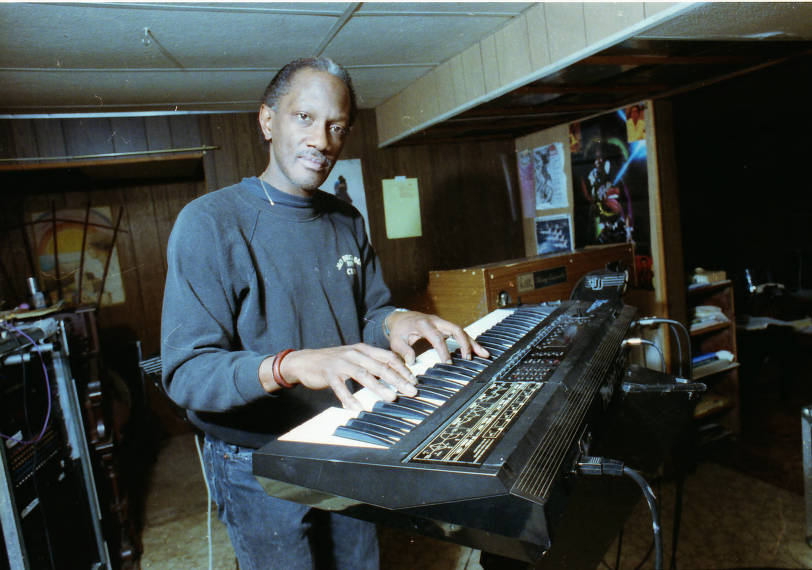 Bernie Worrell
(left image)
Bernie Worrell
(left image)
Courier News Photograph Archive
CN17851 & CN17852
Eddie Hazel (funeral images)
Courier News Photograph Archive
CN11996 & CN11997
Vertical Files are available on site.
Women
This section is ongoing. Please also refer to the Intro page containing some Plainfield Education Firsts.
Online Notable Woman Webpage
Printable "Notable Women" Brochure
 Hazel Fields was born in New York City in 1898 and died in Plainfield in 1986. Over the years of her life she was a teacher, a hospital dietician, a corset saleswoman, a housekeeper, and a friend to many. As a member of the Women’s Achievement Club she worked to bring prominent African Americans to Plainfield to speak of their accomplishments, but one of her greatest contributions to Plainfield was her participation in the New Jersey Historical Commission’s Multi-Ethnic Oral History Project. A transcription of the interview given by her in 1980 is available online here (external link). It presents an invaluable window into the Plainfield that she knew, from her years in the P.H.S. class of 1919 to the time she met Matthew Henson, explorer of the North Pole.
Mary E. Norment, M.D. (1919-1974)
Mary E. Norment was born in Plainfield in 1919. She was graduated from the Evergreen Grammar School and Plainfield High School class of 1935, and completed her undergraduate degree at New York University. In 1943, she received her medical degree from Howard University Medical College, where she was a scholarship student. She went on to work at the Homer G. Phillips Hospital in Missouri, the largest African-American hospital at that time. She married Samaniego Bottler in May 1946 in California. She passed away in 1974.
Adele M . Brown (1893-1974)
Born in Hampden Sydney, VA, in 1893, Adele Brown was the owner and operator of Brown’s Funeral Home for 42 years. She was a member of Calvary Baptist Church, Mohawk Temple 191 IBPOE of the World, Terrell Tent No. 34, and Rebecca Chapter No. 1 Order of the Eastern Star, Prince Hall Affiliate. She was Advisor of the Young Women's Civic Organization of Plainfield, and a member of the executive board of the National North Jersey Unit of the Negro Business and Professional Women's Club. In addition, she was an organizer of the Garden State Funeral Directors Association and the East Fifth Street YWCA of Plainfield, where she was also chairman of the board of governors, and a life member of the National Funeral Directors and Morticians Association. As a nominal director of the NAACP-Plainfield Chapter, she championed the rebuilding of the Moorland Y after it was destroyed by fire in 1955.
As one of four candidates for the Republican councilman nomination in Plainfield's Fourth Ward in 1946, her slogan was, "Clean-Cut Government for the Fourth Ward." Although she did not win the bid, she did not come in last. Adele and husband Andrew started the funeral home in Orange, NJ, in 1918. In 1922, the couple moved to Plainfield and brought Brown's Funeral Home here. When Andrew passed away in 1931, Adele continued as owner, and went on to pass her State Board examinations in 1935. When she passed away many years later in 1974, her daughter Louise maintained the family business.Joanne Hollis (1961-2014)
Joanne Hollis was a life-long resident of Plainfield. She lived in the West End Gardens for over 30 years. A devoted Plainfield activist, Joanne worked as Plainfield Housing Commissioner and served as Councilwoman for the Fourth Ward. In 2015, West End Gardens was renamed Joanne Hollis Gardens in her honor. View a printable history here.
Historical Photograph Collections
The Irving & Clotee Georges Photograph Collection, 1969-1987.
Irving Georges, b. 1933
 As the work of the only living contributor to the Library’s Historical Photograph Collection, the photographs of Irving Georges occupy a unique position within the collection. Unlike each of the other individual collections, these images have entered the archives with the specific intent of helping to create and preserve Plainfield’s visual history. Georges, a semi-professional photographer, and his wife Clotee, donated to the Library their collection of over 5,000 commercially printed snapshots that document over three decades of life in Plainfield.
This collection of color and B&W prints documents the Queen City in the late 1960's, 1970s and 1980s. The collection highlights the Georges family, their neighbors, and community of adults and youth engaged in school & town athletics, local events, and everyday activities.
The Georges collection was featured in the 2010 exhibit, Chronicles of Plainfield. More of this collection can be viewed through the Local History Collections database.
Other Collections
 Contemporary and historical photographs of Plainfield's Black community are located across several photograph collections; these can be searched online using keywords, dates, and other delimiters.
More photographs are contained in our collections of Personal & Family Papers and Clubs & Organization Records. Some of these images have not yet been digitized, but may be searchable through the collection finding aids. Please refer to the Personal Papers and Clubs & Orgs tabs to learn more.
(left image: John Hoffman Collection H3087, names unknown; circa early 1900s)
Search by Collection / Time Period:
General Historical
Collection
(1880-1930; 1970)Reina Lawrence
(early 1900s)Paul R. Collier
(1910-1950)Courier News
(1887-2000s)Contemporary
Photograph Contest
(2006-2019)
The Library's phtographs collections are particularly weak in documenting the 1950s and 1960s of Plainfield. If you have photorgaphs from this (or any) time period that you are interested in donating to us to preserve for future generations, please contact us.
Plainfield Reference & Genealogy Collections
Original Ledgers
Dime Savings Institution, Signature Book GENEALOGY 332.1 SIG
This bank was incorporated in April 1868 and later became the Plainfield Savings Bank in 1883. It was the second bank established in Plainfield, and was located at 14 East Front Street. Because photo identification had not been invented yet, a physical description was provided for all people signing in the ledger in order to allow the bankers to verify a person's identity. 240 Black citizens are recorded. We know their complexion because the records include a notation of "Col", in addition to the physical description comments that all signees received.
Dime Savings Signature Book, Black Customers, 1904-1907. To view the entire index, click here.

Plainfield Police Logs & City Tax Ledgers
 The Library houses 340 ledgers used by the Plainfield Police Division between 1884 and 1971 to record their daily activities. The logs report items such as arrests, accidents, thefts, criminal dockets, tax ledgers, and lost and found animals. Many of the records include ethnic and racial information. Surnames are indexed in many volumes.
Not all ledgers are indexed. Due to fragility or content, access is restricted to some of these ledgers. Please contact the Local History Department for information about the access and use of these volumes. For a detailed list of the Tax Receipt Ledgers, dating from 1883 to 1904, click here.
Click here to learn more and view the available indexes.
Segregation / Race Relations: Reports & Surveys
Charles B. Booker et al VS. The Board of Education of the City of Plainfield, 1963.
PR 344.079 BOO 1963
Charles B. Booker et al VS. The Board of Education of the City of Plainfield, 1964.
PR 344.079 BOO 1964
The Desegregation of the Plainfield New Jersey Public Schools, 1962-1972: A Case Study. By Harold Kennett Schoonover, Dissertation1968.
Booker Excerpt (with timeline)
Human Relations Commission of Plainfield First Annual Report, 1964-1965.
Human Relations Commission of Plainfield First Annual Report, 1964-1965. PR323.1CIT/63-64
In the Matter of an Investigation of Community Unrest in the City of Plainfield, 1979.
In the Matter of an Investigation of Community Unrest in the City of Plainfield, Union County, New Jersey. Docket number 3293-79. Report of the Prosecutor, Union County, New Jersey, October 19, 1979.
The Negro Motorist Green Book Compendium by Victor H. Green, 2019 PR 910.8996 GRE
1947; Image courtesy of New York Public Library |
1954; Image courtesy of New York Public Library |


Obituary for Mrs. Daisy Robinson, The Courier News, April 2, 1965, page 10.
Northtown Survey on Human Relations
Northtown Survey on Human Relations, 1947
The Sixth Grade Plan: An Effort to End Racial Imbalance in the Public Elementary Schools of Plainfield, NewJersey. By Warren E. Dederick, Dissertation, 1967.
Booker Excerpt
A Study of Racial Imbalance in the Plainfield Public Schools by Max Wolff, 1962.
PR 371 WOL
Survey of Negro Life in N.J, Report XX Plainfield
Survey of Negro Life in N.J, Report XX Plainfield, August 1932.
Survey of Recreational Needs in the "West End" of Plainfield, New Jersey
Survey of Recreational Needs in the "West End" of Plainfield, New Jersey, May 1960.
SEE ALSO (external link):
Vanguards of Change in the "Georgia of the North": Youth Activism in the New Jersey Civil Rights Struggle, 1935-1955
Books
PR 366.1 ORD "The Centenial history of Oziel Grand Chapter, Order of the Eastern Star, Prince Hall Affiliation for the jurisdication of New Jersey, Inc. and subordinate chapters" by Order of the Eastern Star. Oziel Grand Chapter (New Jersey), 2014.
AUTHOR BETHEL L "Hornes of Plainfield : a Hermeneutical view African American Life" by Dr. Leonard L. Bethel, 2015.
PR 312 NEG 1790-1915 "Negro Population 1790-1915" by The Department of Commerce, Bureau of the Census, 1918. Available online.
PR 325 HAL "The Negro Wage Earner of New Jersey" by Egerton E. Hall, 1935.
PR 277 PLA "Plainfield's African-American: from Northern Slavery to Church Freedom" by Dr. Leonard L. Bethel, 1998.
PR 366.1 ROS "Rebecca Chapter No. 1 centennial history book, 1914-2014" by Allena E. Ross, 2015.
PR 309.26 STE "The Zone of Emergence: a Case study of Plainfield, New Jersey" by George A. Sternlieb and W. Patrick Beaton, 1972.
Subject: Plainfield Civil Uprising 1967
PR 291.178 DIL "The Broken Mirror: Reflections on Narcissism, Mimesis and Racism in Plainfield, New Jersey," by Elisa Carol Diller, 1996. [Dissertation]
PR 303.623 BOE "Cities Under Siege: An Anatomy of the Ghetto Riots, 1964-1968" edited by David Boesel & Peter H. Rossi, 1971.
NJR 301.541 NEW "Report for Action," by New Jersey Governor's Select Commission on Civil Disorder. 1968. ["The Lilley Report"]
PR 301.451 UNI "Report of the National Advisory Commission on Civil Disorders," (The Kerner Report) by National Advisory Commission on Civil Disorders, 1968. Homeland Secury Dept Library summary online
PR 301.451 UNI "Riots, Civil and Criminal Disorders", United States. Congress. Senate. Committee on Government Operations. Permanent Subcommittee on Investigations, 1967.
PR 364.143 EDW "Somewhere in the Middle: Rebellion, Suburbia, and the Story of Plainfield, New Jersey," by Madera Edwards. 2014. [Dissertation]
PR 364.143 ROA "The Road to Anarchy", Riot Study Commission, NJSPBA, 1968.
PR 974.936 TRE "Insurrection: A Personal Recollection of the 1967 Plainfield City Riot and the Plainfield High School Recail Disturbance of 1969," by Isaiah Tremaine, 2017. The library owns multiple copies of this book. There are two circulating copies avalable from the main floor under Adult-Nonfiction 974.936 TRE.
Slavery in Plainfield
(see also Early Records)
Unfortunately, slavery is an inescapable reality in Plainfield’s past. Not only the well-known Caesar, who served the Drake family, lived at least part of his life in slavery, but many other people whose names are unknown to us today.
Early records are difficult to interpret because Plainfield, once part of Essex County, was not formed as its own township until 1847. Slaves living in the location of the city of today are hidden among the records of Westfield, Essex County, New Jersey. At the highest point during census-keeping years of 1800 there were 1,521 slaves in Essex County. The count dropped to six for the county in 1850.
Early Records on Microfilm
As a Family Search Affiliate Library, we can offer extended access to their numerous microfilm holdings. To provide easier access, the Library has created three indices to early records available on microfilm via FamilySearch.com. These have been compiled from FamilySearch Microfilm Reel No. 007899519, "Slave Receipts; Deeds of Manumission; Birth records of Black Children; Slaves in Essex county."
African Slaves and Free Persons of Essex County, 1791-1795
Birth Records of Black Children in Essex County, 1804-1807.
Wills Listing Slaves in Essex County, 1768-1820.
Local History Department volunteer, Barbara Polk Riley, has transcribed and indexed the records found in FamilySearch microfilm # 007899519:
Certificates of Birth of Black Children (Essex County, NJ), 1804-1822.
Certificates and Deeds of Manumissions (Essex County, NJ), 1805-1853.
Slave Receipts (Essex County, NJ), 1787-1805.
Additionally, New Jersey State Library microfilm reel #CSOCL003
Somerset County Register of Black Children (Children of Slaves), 1804-1824.
We are in the process of making the digital images accessible online, please contact for image information.
Early Newspapers
On August 30,1849, page 3, the Plainfield Gazette advertised a twelve-year-old girl for sale, listed casually beside the latest prices for flour and potatoes. Her fate is unknown.
 |
Slave Enumeration Schedules
In New Jersey, slaves were not counted by name until 1860. They were listed separately in “Slave Inhabitant” or “Slave Enumeration” schedules under the names of slave owners. The first schedule for New Jersey was in 1850.
In 1850, the slave enumeration for Plainfield, then part of Essex County, lists one slave. This person, only counted as Age 57, Female, and Black, was listed as being owned by James Compton, whose name is cut off in the schedule. However, because she was mistakenly listed in the Free Inhabitant Schedule with Compton’s household, we know her name: Hannah Vermeule. Hannah was not listed anywhere in the 1860 census for New Jersey.
There are two other enslaved individuals counted on this page, both in Westfield. Like with Hannah Vermeule, their names were located with the 1850 Free Inhabitant Schedule: Polly Vanderer (said to be property of Ezra Miller) and Juda Denman (said to property of John Denman).


The historical census records pictured above are maintained and released by the National Archives and Records Administration, not the U.S. Census Bureau. You can access these records via the Library's subscription to the Ancestry.com online database.
By 1860 there were 43 slaves listed in the regular New Jersey census (not the Slave Inhabitants Schedule), with one living in Plainfield, Dinah Brown. Most were living in Bergen County, and all were born between 1760 and 1806. View the list here. Former slaves are known to have lived in Plainfield as recently as 1915, their pasts in slavery identified in their obituaries. Lives so difficult to comprehend today ended fewer than 100 years ago.
Recorded Programs
Hidden History Stories of Early Local African Americans presented by Nancy A. Piwowar, Historical Society of Plainfield / Drake House Museum in September 2020.
External Resources
10 Databases for Slave Genealogy
Northeast Slavery Records Index (NESRI)
The Northeast Slavery Records Index (NESRI) is an online searchable compilation of records that identify individual enslaved persons and enslavers in the states of New York, Maine, New Hampshire, Vermont, Massachusetts, Rhode Island, Connecticut, New Jersey and Pennsylvania. NESRI indexes census records, slave trade transactions, cemetery records, birth certifications, manumissions, ship inventories, newspaper accounts, private narratives, legal documents and many other sources.
Houses of Worship
The Local History Department maintains vertical files of newspaper articles and some original materials for numerous early Black churches in Plainfield. For the those below, we have photographs, postcards, and some ephemera in our historical collections. For more information, please refer to the Library's collection of early Plainfield newspapers and early issues of the Courier News.
Please also see the Library's online exhibit, Building Faith in Plainfield, Exploring the City's History Through It's Houses of Worship.
Bethel Chapel
 |
East Fifth Street and Washington Street The Crescent Avenue Presbyterian Church organized the Bethel Chapel in 1884, as a traditionally African-American chapel. It was built in 1887 at the Corner of East Fifth Street and Washington Street (later known as Roosevelt Avenue). Image: Bethel Chapel, Circa 1920s-1940s. |
Calvary Methodist / Baptist Church
 |
West Fourth Street at Monroe Avenue
Calvary Baptist Church started April 27, 1895, with twenty members, some from Mount Olive Baptist. The Church building was dedicated on July 30, 1898, between West Fourth and West Second streets. In 1960, the congregation relocated into the old Monroe Avenue Methodist Church building. |
 |
(top image) Calvary Baptist Church, Circa 1920s-1940s. (bottom image ) Calvary Methodist Church, Postmark 1927 |
Mount Olive Baptist Church
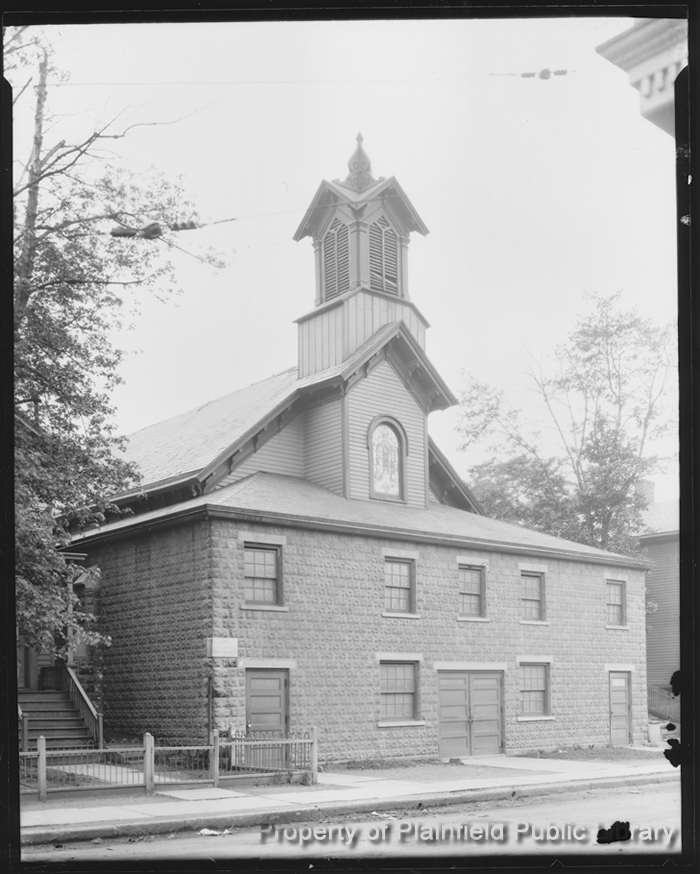 |
216 Liberty Street Mount Olive Baptist Church was organized in 1870 and groundbreaking for what was to be Plainfield’s first Black church occurred on March 1, 1871 at the intersection of Third and Liberty streets. The first pastor was Rev. John Cary and the congregation consisted of fourteen members. The church grew rapidly to 500 members, but declined as branch churches were organized: Shiloh Baptist and Calvary Baptist. Image: Mount Olive Baptist Church, circa 1920s-1930s by Paul R. Collier, Photographer. |
|
|

Vertical File:
Mount Olive Baptist Church History Handout
Images:
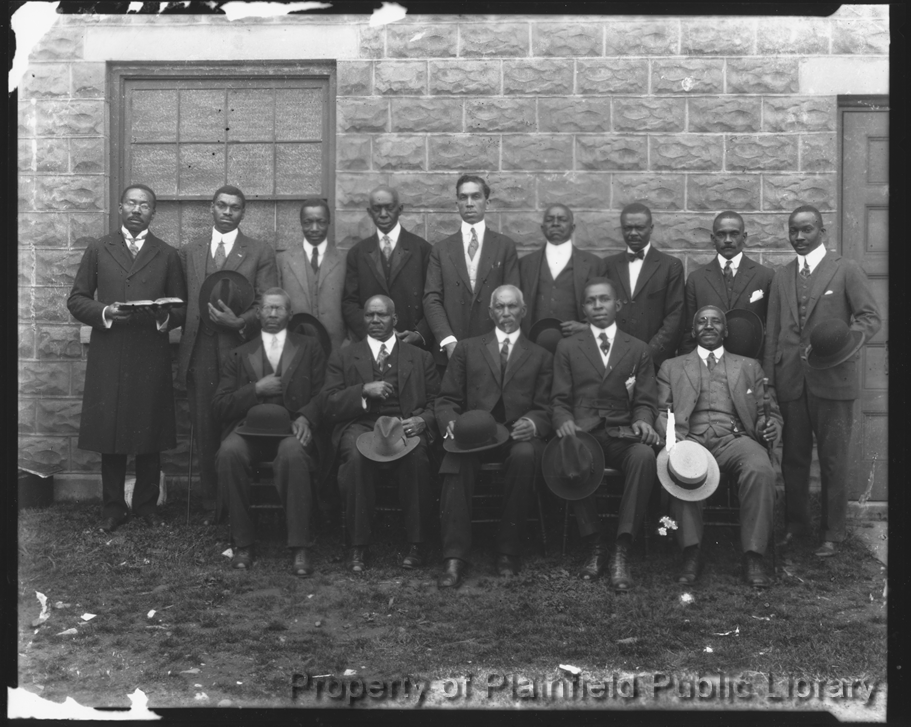
Pastor and Early Builders of Mount Olive Baptist Church
Circa 1910s
Paul R. Collier, Photographer
In 1873, Rev. John D. Bagwell, pastor of Mount Olive Baptist Church. started the first Black newspaper in Plainfield, the New Jersey State Republican. Later, Rev. Dr. E. E. Jackson, also of Mount Olive, published the Plainfield Herald. Learn more about these early newspapers here.
Mount Zion African Methodist Episcopal Church
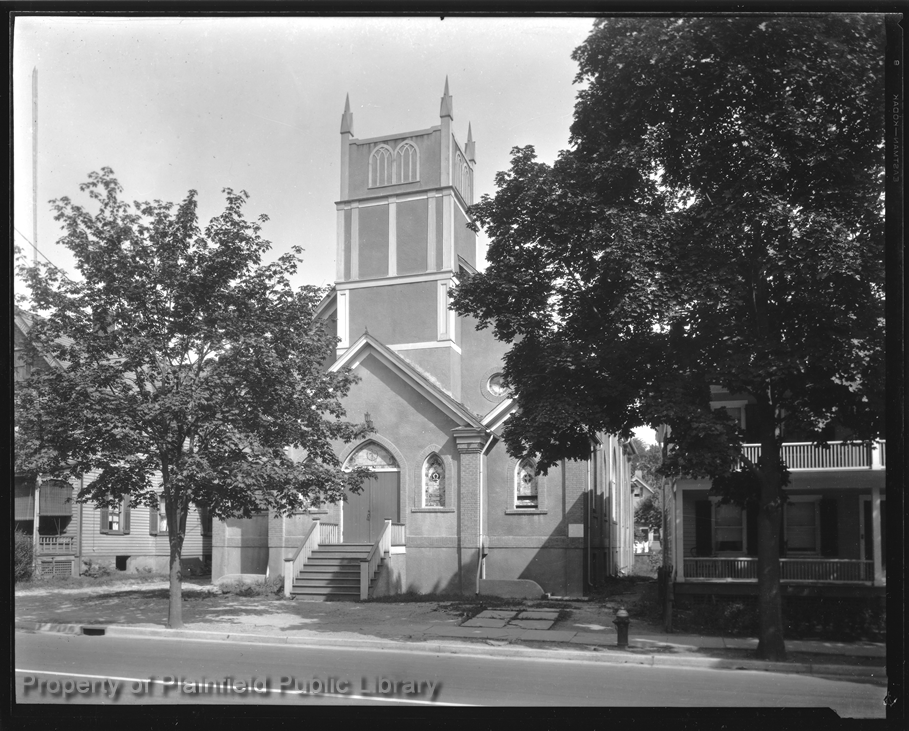 |
527 West Fourth Street The Mount Zion A. M. E. Church began on July 26, 1892. The first chapel was built on West Fourth Street in 1893; it was known as “Little Mount Zion Church.” In 1925, a new church building, “Greater Mt. Zion,” was completed. Image: Mount Zion A. M. E. Church |
Shiloh Baptist Church
 |
515-521 West Fourth Street Established on May 17, 1908, Shiloh Baptist Church was the second church to arise from the Mount Olive Baptist Church. The Church’s seventeen charter members worshipped initially in Reform Hall. They purchased the existing structure at 515-521 West Fourth Street and remodeled it to use as the first church building. Construction was completed in the 1930s. Image: Shiloh Baptist Church, circa 1930s by Paul R. Collier, Photographer |
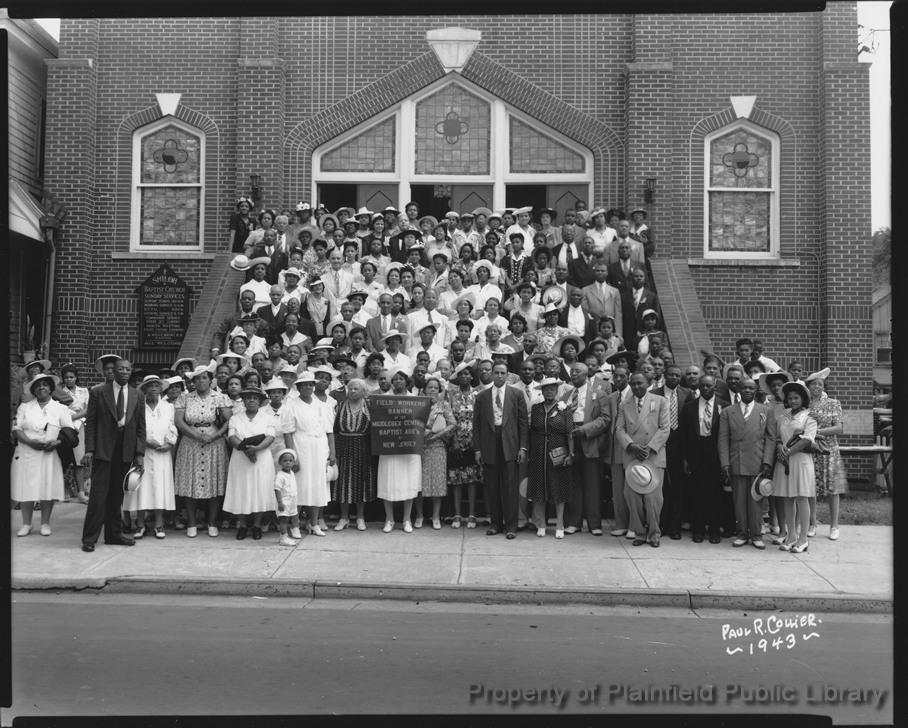 |
From the 1950s through the 1990s, the congregation grew extensively and outgrew the existing structure. The original wooden church was demolished and the land turned into a parking lot. A new Parish House was built and other renovations were completed in 2005. Image: Shiloh Baptist Church Congregation, 1943 by Paul R. Collier, Photographer Ephemera: |
Additional Resources
Recorded Programs
The Local History Department and the Historical Society of Plainfield often host virtual programs via Zoom. Most webinars offer inclusive topics in history and genealogy. However, the programs listed below focus on Black history or genealogy. A full list of recorded webinars is available. Please subscribe to our YouTube channel and our e-newsletter.
| Program Title & Speaker |
| Introduction to African American Genealogy / Presented by Janice Cross Gilyard |
| Introduction to Afro-Caribbean Genealogy Resources / with genealogist Sharon Wilkins. |
| Plainfield's Black History: The Black Experience, Plainfield NJ. with historians Martin & Tristian Cox |
| Finding Native Americans in African-American Families with genealogist Angela Walton-Raji |
| Afro-Dutch Cultural Legacy in NY and NJ with Teresa Vega, cultural anthropologist and genealogist |
| Exploring Your Roots: African American Genealogy at the Library of Congress with Ahmed Johnson (Library of Congress) |
| Photo Journalism: Black Lives Matter, "A Fight for Change" with Kalani Jimenez-Mackson |
| Hidden History Stories of Early Local African Americans with Nancy A. Piwowar |
| ||||||||


